A camera sees a scratch, a customer describes a double charge, and a technician dictates a repair note. A neural network can turn each input into something useful, but the outputs are different: an inspection flag, a queue label, and a sequence of words. The right way to judge the network depends on what someone will do with that output.
For the mechanics of learning from examples, start with how neural networks learn and compare with simpler models. Here the question is whether a network helps with a particular job. The following scenarios illustrate how to choose and evaluate a tool; the metrics are not results from a test.
Vision: flag a damaged part for inspection
A fixed camera photographs each finished part. A visual anomaly detector can learn what an undamaged surface looks like and give a new photo an anomaly score. Above a chosen threshold, an inspector checks the part. That is an image-level decision: a flag does not tell the inspector where the scratch is. A system trained to locate damage might instead return a region, such as a bounding box around a suspected defect.
Compare the flags with inspectors’ labels on a held-out production run. Defect recall is the share of defective parts flagged. Pair it with the share of good parts flagged: a system that stops the line for every part catches every defect but is of little use. Glare can look like damage, so check both rates after a lighting change.
If the only fault is a missing dark mark at a fixed position, start with a brightness threshold in that patch. Consider a learned model when the defects vary in shape or location. The MVTec AD research paper provides a concrete comparison setting: defect-free training images, test defects such as scratches, and labeled defect regions. Its benchmark is not a substitute for checking your own parts.
Text: route a support request without writing the reply
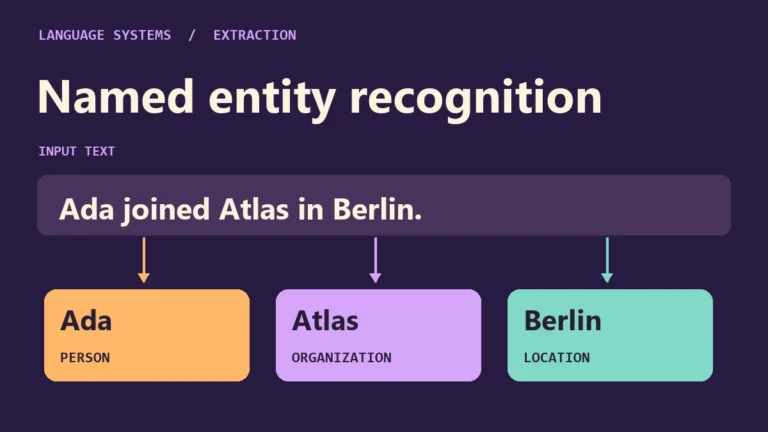
“My renewal went through twice” should reach billing even though it never says “charge.” A text classifier takes the message and scores the available queues, such as billing, delivery, and account access. It returns a label, not a diagnosis or a customer-facing answer. Train against corrected routes rather than the first queue that received a ticket.
On later tickets, check precision (how many tickets sent to billing belong there) and recall (how many true billing tickets it finds). Repeat for each queue: good overall accuracy can hide missed requests to a small team. A message about both a refund and a locked account may not have one right label; send ambiguous cases to a person.
If customers reliably select their issue from a short menu, route by that field. For free text, compare against keyword rules before adding a network. The Hugging Face text classification guide shows how a transformer maps text to labels using movie reviews; ticket queues would need their own labels. For tasks beyond routing, see other real-world applications of natural language processing.
Speech: draft a repair note from a recording
With the speaker’s consent, a technician’s recorded note becomes the input to a speech recognizer. Its output is a draft transcript. Compare that draft with a human transcript of the same recording: word error rate counts substituted, deleted, and inserted words, divided by the number of reference words. Use the same conventions for numbers and punctuation in both texts.
An average can hide the error that matters: “replace valve B” is not “replace valve D.” Check part IDs separately and have the technician confirm them. The Whisper model card notes that transcripts can include words never spoken and that performance varies across accents. For more on the audio-to-text path, see how neural networks recognize speech.
If the job only requires a part ID and a status, scanning a barcode and selecting a status avoids transcription entirely. Dictation earns its place when the technician needs to describe an unexpected problem in their own words.
How to decide whether the network is worth using
Write down the action first: stop a part, route a ticket, or save a note. Compare the simplest workable option and the network on the same unseen jobs, including exceptions. Count the cost of mistakes and human corrections alongside the chosen metric. If a rule or a form delivers the needed outcome, there is no benefit in predicting a value you can collect directly.
For a technical treatment of learned representations across images, language, and audio: As an Amazon Associate I earn from qualifying purchases. Deep Learning by Ian Goodfellow, Yoshua Bengio, and Aaron Courville (hardcover, Amazon US).