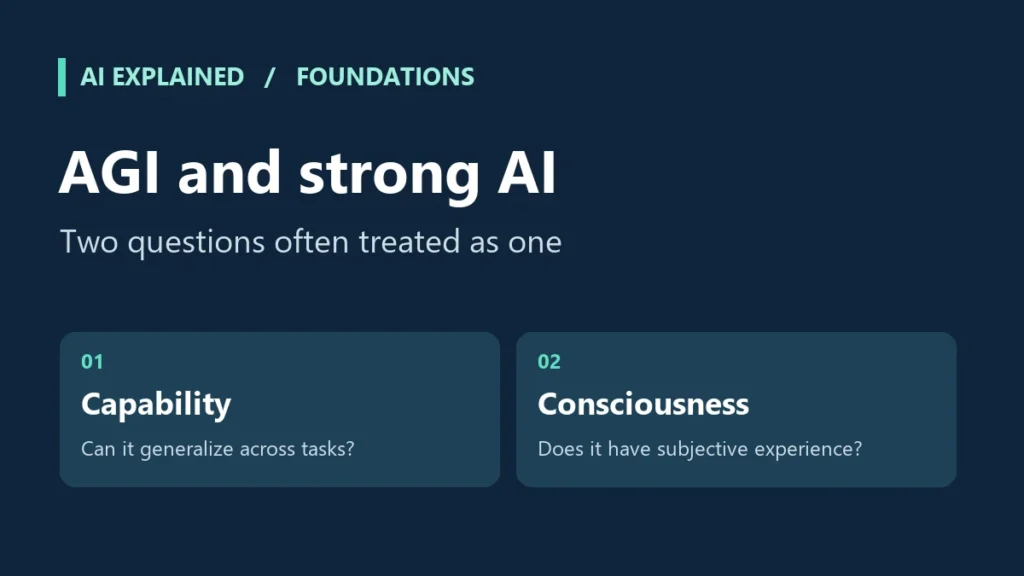
Does a computer understand what it is doing, or can it just do many different things well? “Strong AI” has been used for both ideas. In philosophy, the question is whether running the right program is enough for a machine to have a mind. When strong AI is used to mean artificial general intelligence (AGI), the question is about capability: how well can skills transfer across tasks? Performance alone does not establish consciousness. Superintelligence (ASI) is a separate idea: a system that would far exceed human ability. No system is broadly accepted as strong AI today, and researchers still disagree on how to define or test for it.
An earlier version of this article treated strong AI as a synonym for superintelligence. That was wrong, and the comparison below replaces it.
Weak AI, strong AI, AGI and ASI at a glance
| Term | What it means | Exists today? |
|---|---|---|
| Weak AI (narrow AI) | A system built and trained for a specific task or a bounded family of tasks | Yes; for example, a spam classifier |
| AGI (sometimes called strong AI) | Human-level ability to learn and transfer skills across a broad range of tasks; proposed thresholds vary | No broadly accepted example |
| Strong AI (philosophical sense) | The position John Searle argued against in 1980: a suitably programmed computer would literally have a mind, not just simulate one | An open philosophical debate, not an engineering milestone |
| Superintelligence (ASI) | A system that greatly exceeds the best human performance across almost every domain | No. Purely hypothetical |
The term “strong AI” comes from philosopher John Searle’s 1980 paper Minds, Brains, and Programs, which introduced the Chinese Room argument against it. The Stanford Encyclopedia of Philosophy entry on the Chinese Room summarizes that debate. Some industry guides, including the AWS introduction to AGI, use strong AI as another name for AGI. In their Levels of AGI framework, Meredith Ringel Morris and colleagues distinguish breadth (how many kinds of tasks) from performance (how well). Beating a chess champion demonstrates exceptional performance in one game, not general superintelligence.
A developer’s mental model
Think of a narrow AI model as a function with a fixed signature: classify(image) -> label or score(transaction) -> fraud_risk. You can retrain it to make it better at that job. You cannot call it with a different job.
Strong AI would be closer to a new colleague than to a function. Hand it an unfamiliar problem, some documentation and a few examples, and it would work out how to solve it, then reuse what it learned on the next problem.
The analogy breaks in two places. Comparing a system with a person suggests understanding or intent, which is exactly what Searle’s argument disputes: performing a task and having a mind are not the same claim. Today’s large language models also blur the “fixed signature” picture. One model accepts almost any text as input and handles many tasks. They still fail in ways a competent person would not, can state wrong facts confidently and do not reliably learn from a conversation once it ends. Success on some tasks does not settle whether a model meets a proposed AGI threshold.
Strong AI examples
Because no accepted strong AI exists, the examples are capabilities that would count as evidence, not products:
- Learning a new professional skill, such as a new programming language and its ecosystem, from the same material a person would use, then applying it reliably.
- Transferring knowledge between unrelated domains without being retrained for each one.
- Planning and carrying out a long, multi-step goal in an unfamiliar environment, recovering from its own mistakes along the way.
Fictional examples such as HAL 9000 are often cited, but they describe stories about minds, not engineering specifications.
Benefits and risks discussed for strong AI
Discussions of AGI usually weigh the same set of possibilities. On the benefit side: faster scientific research, automation of complex knowledge work, and help with problems that need expertise across many fields at once. On the risk side: job displacement, misuse for cyberattacks or disinformation, decisions with ethical consequences made without accountability, and the difficulty of keeping a highly capable system aligned with human intentions and under human control. These are forecasts and policy questions. Treat confident predictions in either direction with caution.
What this means if you build software
Even a general-purpose model has failure modes. What matters for engineering is its error rate on the particular task you deploy it for. Design around that: define the task, test it with known inputs and expected outputs, and keep a human or a deterministic check where mistakes are costly. For the other side of the comparison, read what weak AI is and how it is used today. For the basic building block, see what the term “model” means in AI.
For a textbook treatment of what AI agents can perceive, learn and do, see Russell and Norvig’s Artificial Intelligence: A Modern Approach (4th edition). As an Amazon Associate I earn from qualifying purchases. View the hardcover on Amazon US.