

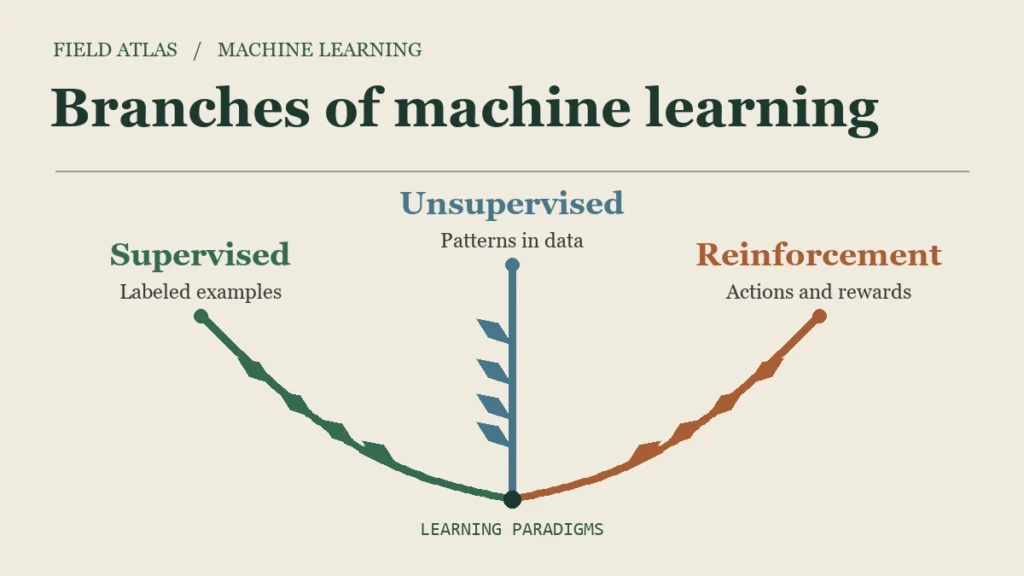
The main branches of machine learning differ in what the learner gets to learn from: a known answer, patterns in data without answers, or rewards for actions. The diagram below also names neural networks and ensembles. Those describe how a model is built, not what feedback it receives. A neural network can learn under any of the three setups.
One bike-share system, three ways to learn
- Supervised learning: predict a known target. Pair each station’s morning conditions with the recorded number of rentals that afternoon. Predicting that count is regression. Predicting whether the station will run out of bikes is classification. In either case, test on later days that were not used for training; never use afternoon rental totals as a morning input.
- Unsupervised learning: find structure without target labels. Use hourly rental profiles to group stations by when they are busy. A morning-peak group might suggest a commuter route, but the grouping alone cannot tell you why people ride. Check whether the pattern recurs in another month.
- Reinforcement learning: choose actions with consequences. A dispatcher sees station inventories (state), sends a truck to move bikes (action), and earns a reward for trips served minus travel cost. Moving a bike now changes where it is available later. Evaluate the policy over a whole day, for example against a fixed route in a simulator. Forecasting demand alone does not learn a dispatch policy. See how reinforcement learning uses an agent, an environment, and rewards.
The three setups can overlap. With a few stations labeled “commuter” and many unlabeled, semi-supervised learning uses both sets for the same prediction task. In self-supervised learning, the data supplies its own targets: hide part of a rental history and train a model to predict the missing observations. Neither requires a reward for an action.
Text guide to the original machine learning map
The figure draws four lines from “Machine Learning.” Read them as an index to related ideas, not four mutually exclusive branches. Here is the map in text, including its smaller labels.

- “Classical Learning” splits into supervised and unsupervised tasks. On the supervised side, classification lists k-nearest neighbors (kNN), logistic regression, naive Bayes, decision trees, and support vector machines (SVMs). Regression lists linear, lasso, ridge, and polynomial regression. On the unsupervised side, clustering lists fuzzy c-means, k-means, DBSCAN, and mean shift. Pattern search lists Apriori, FP-growth, and a label printed as “Eucat” (apparently Eclat). Dimensionality reduction and visualization lists PCA, LDA, SVD, t-SNE, QDA, LSA, and LLE. One correction: if LDA means linear discriminant analysis, it uses class labels. Quadratic discriminant analysis (QDA) is also a supervised classifier, not an unsupervised visualization method.
- Reinforcement learning includes Q-learning, deep Q-networks (DQN), A3C, and SARSA. The figure also places genetic algorithms here. They are optimization methods: they can search for a policy, but are not specific to reinforcement learning.
- Ensemble learning combines models. The map shows stacking, bagging (with random forest), and boosting (AdaBoost, gradient boosting, XGBoost, CatBoost, and LightGBM). A random forest predicting tomorrow’s rentals is both an ensemble and a supervised regression model.
- Artificial neural networks include multilayer perceptrons (MLPs), recurrent networks (RNNs; the map names LSM, LSTM, and GRU), radial basis function networks, modular networks, generative adversarial networks (GANs), autoencoders, and convolutional networks (CNNs, including deep CNNs). The “seq2seq” label near autoencoders means sequence-to-sequence; translating a sentence into another language is a sequence-to-sequence task, not reconstruction of the input.
Start with the feedback your task actually provides. Once you know whether you are predicting a target, discovering structure, or choosing actions, use our guide to machine learning algorithms to explore model choices.
Sources and further reading
Google’s introduction to machine learning distinguishes the training signals; its glossary entry on self-supervised learning explains how examples supply their own labels. The scikit-learn documentation covers learning from partly labeled datasets and linear and quadratic discriminant analysis.
Book for practice: To move from these distinctions to training models in Python, see Aurélien Géron’s book. Affiliate disclosure: As an Amazon Associate, we earn from qualifying purchases. Hands-On Machine Learning with Scikit-Learn, Keras, and TensorFlow: Concepts, Tools, and Techniques to Build Intelligent Systems (Amazon.com).


