LAVIS is a Python deep learning library for LAnguage-and-VISion research and applications. It features a unified design to access state-of-the-art foundation language-vision models (ALBEF, BLIP, ALPRO, CLIP), common tasks (retrieval, captioning, visual question answering, multimodal classification etc.) and datasets (COCO, Flickr, Nocaps, Conceptual Commons, SBU, etc.).
This library aims to provide engineers and researchers with a one-stop solution to rapidly develop models for their specific multimodal scenarios, and benchmark them across standard and customized datasets. It features a unified interface design to access:
- 10+ tasks (retrieval, captioning, visual question answering, multimodal classification etc.);
- 20+ datasets (COCO, Flickr, Nocaps, Conceptual Commons, SBU, etc.);
- 30+ pretrained weights of state-of-the-art foundation language-vision models and their task-specific adaptations, including ALBEF, BLIP, ALPRO, CLIP
Key features of LAVIS include:
- Modular and Extensible Library Design: facilitating to easily utilize and repurpose existing modules (datasets, models, preprocessors), also to add new modules.
- Easy Off-the-shelf Inference and Feature Extraction: readily available pre-trained models let you take advantage of state-of-the-art multimodal understanding and generation capabilities on your own data.
- Reproducible Model Zoo: provided training/pre-training recipies to easily replicate and extend state-of-the-art models.
- Dataset Zoo and Automatic Downloading Tools: it can be a hassle to prepare the many language-vision datasets. LAVIS provides automatic downloaing scripts to help prepare a large variety of datasets and their annotations.
Other features include:
- Distributed Training using multiple GPUs on one machine or across multiple machines.
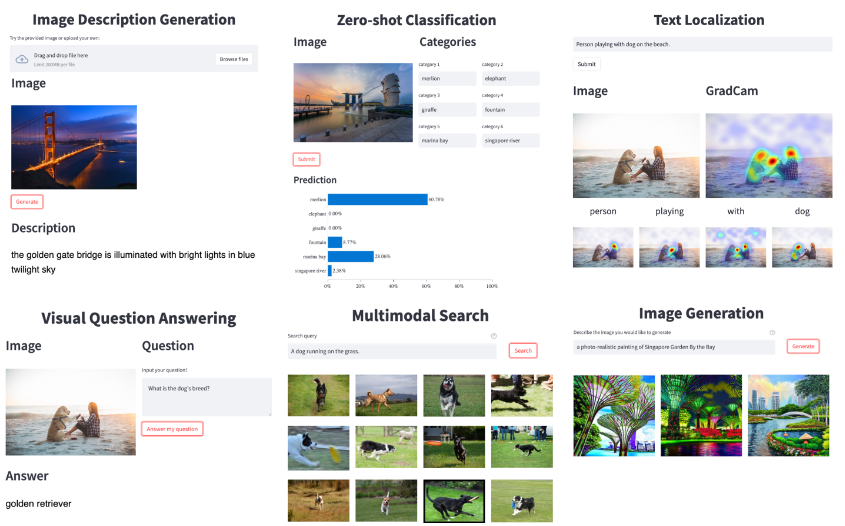
- Web Demo: try supported models on your own pictures, questions etc.
- Leaderboard: comparing state-of-the-art models across standard datasets.
- Dataset Explorer: help browse and understand language-vision datasets.