

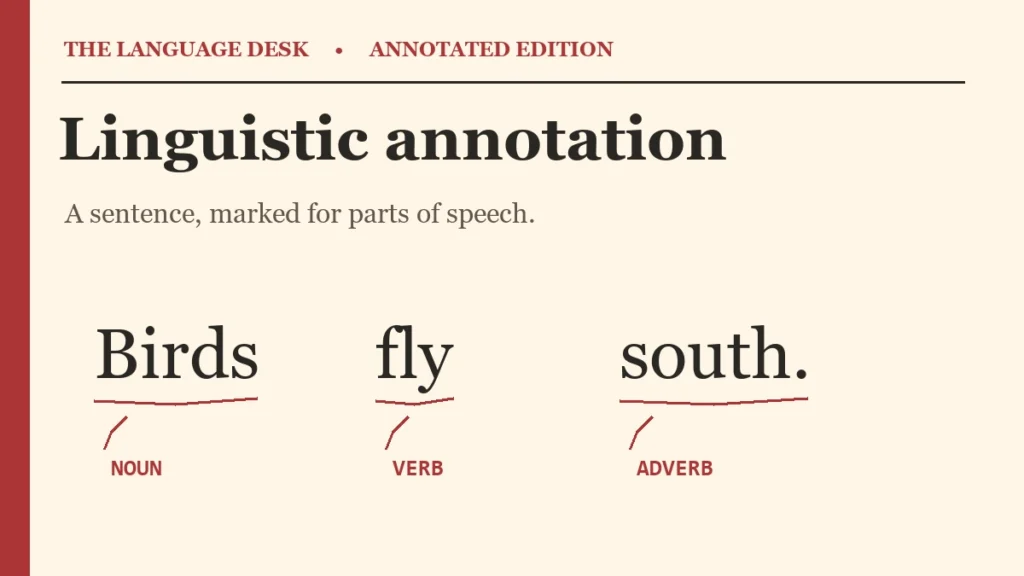
Linguistic annotation is the process of adding labels to text or speech so that a program can learn from it or be tested against it. A label can mark a word’s part of speech, a person or place name, the grammatical link between two words, the sentiment of a sentence, or who is speaking in a recording. The text stays the same. The annotations are structured metadata layered on top of it.
If you write software, think of annotated text as a test fixture with expected values. The raw sentence is the input, and the annotations are the answers a model should produce. Training, the build step that turns example data into a model, uses those answers to adjust the model’s parameters. Evaluation compares the model’s output with annotated answers it has never seen, much like running a test suite against a new build.
The analogy breaks in one important way. A unit test’s expected value is a fact that you wrote down. A label is a human judgment. Two careful annotators can disagree about the same sentence, and a model trained on their labels learns those disagreements too. The quality checks later in this article deal with that gap.
What linguistic annotation means in practice
Take the sentence Ada Lovelace wrote notes in London. A token-level annotation could look like this, with a part-of-speech tag and a named-entity tag for each token:
| Token | Part of speech (UPOS) | Entity (BIO) |
|---|---|---|
| Ada | PROPN | B-PER |
| Lovelace | PROPN | I-PER |
| wrote | VERB | O |
| notes | NOUN | O |
| in | ADP | O |
| London | PROPN | B-LOC |
| . | PUNCT | O |
B- marks the first token of an entity, I- a token inside the same entity, and O a token outside any entity. The part-of-speech column uses the universal tag set from the Universal Dependencies CoNLL-U format, a widely used plain-text format with one token per line and tab-separated columns.
Many annotation tools store the same information as character offsets instead of per-token tags:
{
  "text": "Ada Lovelace wrote notes in London.",
  "entities": [
    {"start": 0,  "end": 12, "label": "PERSON"},
    {"start": 28, "end": 34, "label": "LOCATION"}
  ]
}
Offsets survive changes in tokenization, which matters when the model and the annotation tool split words differently. Token tags are easier to read and to feed into sequence-labeling models. Pick one format per dataset and convert at the boundary.
Types of linguistic annotation
| Layer | What it labels | Typical use |
|---|---|---|
| Tokenization and sentence boundaries | Where words and sentences start and end | Preprocessing for every other layer |
| Part of speech and lemma | Word class (noun, verb…) and dictionary form | Search, grammar checking, feature extraction |
| Syntactic dependencies | Which word modifies or governs which | Parsing, relation extraction |
| Named entities | People, organizations, places, dates, products | Information extraction, search, redaction |
| Coreference | Mentions that refer to the same thing (Ada … she) | Summarization, question answering |
| Semantic roles and relations | Who did what to whom; links between entities | Knowledge graphs, contract and report analysis |
| Sentiment, intent and topic | Labels for a whole sentence or document | Support triage, chatbots, monitoring |
| Speech layers | Transcript, timestamps, speaker turns, pauses, overlaps | Speech recognition, diarization, voice assistants |
Entity work has its own articles on this site: entity annotation covers labeling entities in training data, and entity extraction covers the model that finds them in new text.
Annotating spoken language versus written text
Spoken language serves a wider range of purposes than most written corpora capture: conversation, instructions, negotiation, small talk and storytelling, often with several people talking at once. A transcript alone loses much of that. Speech annotation therefore adds layers that written text does not need:
- Time alignment. Each word or segment is linked to a start and end time in the audio.
- Speaker turns. Who is speaking, including interruptions and overlapping speech.
- Disfluencies. Repetitions, false starts and fillers such as um, which carry meaning in conversation but break text-trained parsers.
- Prosody. Stress, pitch and pauses that can turn a statement into a question.
Decide early whether you annotate the cleaned transcript or the verbatim speech. A model trained on cleaned text will struggle with real call-center or meeting audio, and the reverse is also true.
How AI systems use annotated data
- Training. Supervised models such as taggers, entity recognizers and classifiers learn directly from labeled examples.
- Evaluation. A held-out annotated set is the regression test for a language feature. Without it, you cannot tell whether a model change, a prompt change or a new LLM version made results better or worse.
- Fine-tuning and checking large language models. LLMs reduce the need to train a tagger from scratch, but teams still need labeled examples to fine-tune, to write few-shot prompts and above all to measure output quality.
- Information extraction. Annotations define the target schema, for example which fields to pull from an invoice or a support ticket, and give you examples to validate against.
Quality: guidelines and agreement
Annotation quality limits model quality. Three practices make the difference:
- Written guidelines with examples and edge cases. Is Apple in “Apple pie” an organization? The guideline answers that once, not once per annotator.
- Double annotation on a sample, with an agreement score such as Cohen’s kappa. Low agreement usually means the guideline is ambiguous, not that the annotators are careless.
- Versioned datasets. Treat the annotated set like code: record the guideline version, review changes and never mix test examples into training data.
Open-source tools such as Label Studio, doccano and INCEpTION provide annotation interfaces, user management and export to common formats. A pre-trained model or an LLM can propose labels for humans to correct, which is usually faster than labeling from scratch. Measure how often reviewers change the proposed labels, so that you know the pre-labels help rather than bias the result.
Limits
Annotation is slow and expensive, and labels encode the choices of whoever wrote the guideline. A dataset annotated for news articles will not transfer cleanly to medical notes or chat messages. Before you label thousands of examples, annotate a small sample, train or prompt a baseline, and check whether the labels you chose are the ones your application actually needs.
For a wider view of where these techniques are used, see natural language processing applications in the real world.
Further reading: As an Amazon Associate I earn from qualifying purchases. Natural Language Annotation for Machine Learning: A Guide to Corpus-Building for Applications by James Pustejovsky and Amber Stubbs.


